 1-800-529-8255
 1-800-529-8255

 Back
Back
 Trip and Fall: $200,000 Recovered
 Fireball Collision in Downtown LA
Investigators believe that alcohol intoxication was a factor in a September 14, 2025, crash that seriously injured a half-dozen motorists...
Read More
8730 Wilshire Boulevard, California 90211 
Get Help Now

Request A free confidential case review

Case Results :
Recently Written:
Investigators believe that alcohol intoxication was a factor in a September 14, 2025, crash that seriously injured a half-dozen motorists...
Read More

Mostly thanks to advancing technology, fatal airplane accidents are very rare. However, statistics don’t comfort people who lose friends or...
Read More

One reason for these delays is the difference between fault and liability. A fault admission at the scene, or even...
Read More
The actor told police that a garbage truck ran him off the road, prompting an October 2025 car crash in...
Read More
For many people, a sightseeing tour of the Nevada desert, or a skywatching trip to this remote area, is the...
Read More
Partner with our experienced attorneys and take the first step toward justice.
Get Your Free Consultation
The Graves Amendment is an obscure federal law that limits the liability of Enterprise, U-Haul, and other vehicle rental companies when their vehicles are involved in serious injury or fatal collisions.
Vicarious liability is often critical in these crashes. Most vehicle renters decline the extra insurance option (we know we normally decline it). As a result, U-Haul and Enterprise vehicle operators are basically uninsured.
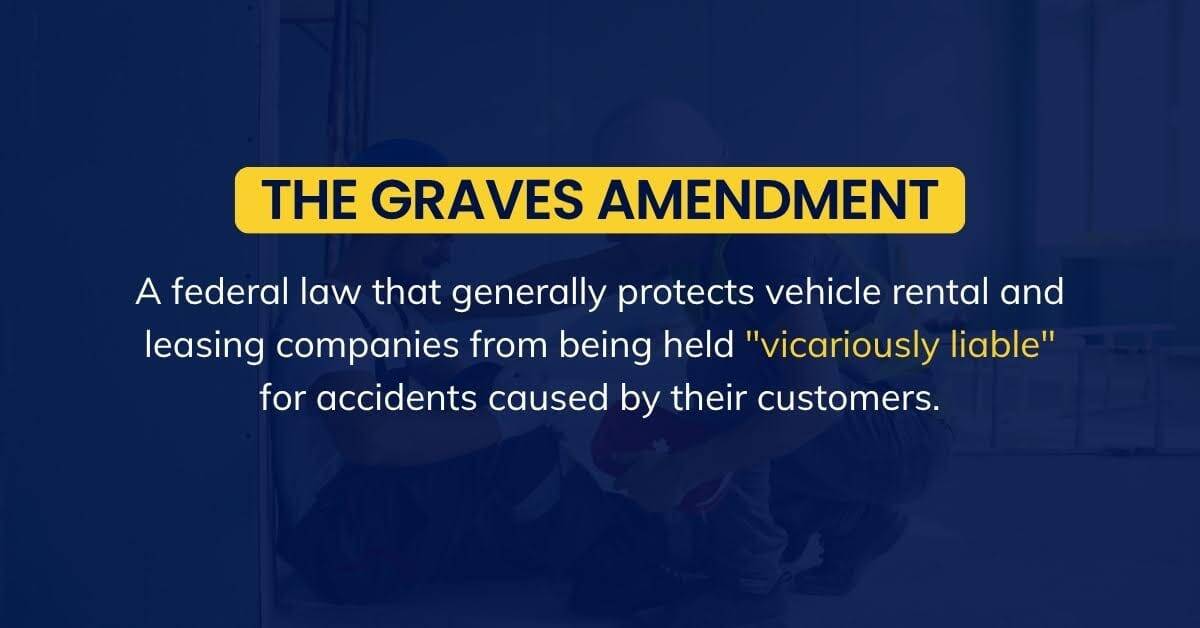
Lawmakers wanted the Graves Amendment to undercut the broad vicarious liability laws in states like California. However, as outlined below, the Graves Amendment has two key loopholes that a California personal injury lawyer can exploit.
Vicarious liability is Legalese for third-party liability. We understand this phrase isn’t much clearer, so let’s break it down.
Negligent entrustment is one of the most common vicarious liability theories. This rule often applies when owners knowingly allow incompetent drivers to use their motor vehicles. Common situations include a roommate borrowing a friend’s car and a teenager driving a car that legally belongs to a parent.
According to California law, “Every owner of a motor vehicle is liable for injury or damage caused by negligent operation of vehicle by any person using a vehicle with permission, express or implied, of the owner.” Since owners can stop crashes before they happen, simply by withholding the keys, owners have special responsibilities in the Golden State.
All negligent entrustment cases are complex. Commercial negligent entrustment cases are even more complex because of the Graves Amendment. More on that below.
Respondeat superior employer liability is another good example. A ship captain is responsible for the behavior of the sailors. Likewise, employers are responsible for damages if their employees negligently cause crashes during the course and scope of employment.
California’s broad vicarious liability law applies to commercial as well as non-commercial negligent entrustment cases. But because of the Constitution’s Supremacy Clause, federal law trumps it. So, Graves Amendment immunity applies to commercial negligent entrustment cases, unless a Los Angeles personal injury lawyer short-circuits this provision.
First, a bit of background. Congress added the Graves Amendment to a large transportation bill. Like many such add-ons, the Graves Amendment is poorly drafted. As a result, two glaring loopholes are in its two main liability protection provisions.
Negligent entrustment immunity only applies if the vehicle’s owner was in the “trade or business” of renting vehicles, according to the law.
As mentioned, the brief Graves Amendment is poorly drafted and does not define this key phrase. Therefore, a lawyer must look elsewhere. The most likely place to look is the Uniform Commercial Code, which is the Bible for commercial transactions in the United States.
The UCC doesn’t define trade or business. But it defines merchant, a similar phrase, as an entity that deals in goods of a particular kind. Liquor stores usually sell candy bars. But these entities are liquor stores, not candy stores.
Similarly, many vehicle rental companies, especially U-Haul companies, are moving supply companies that have a few trucks in the parking lot.
Since such a company is not a dealer in a particular kind, Graves Amendment immunity arguably does not apply.
Furthermore, if the owner or agent was negligent during the transaction, immunity is unavailable. Failure to scan a drivers’ license is the most common form of negligence in these situations.
Lawmakers approved the Graves Amendment in the early 2000s, when license checks were limited to visual inspections. Now, a driving record scan is the industry standard. Failure to adhere to the industry standard is almost always negligence.
So, especially since negligent entrustment matters are sometimes straightforward in California, because of the way the law’s written, the Graves Amendment normally does not derail a U-Haul or other rented vehicle crash claim. Instead, the Graves Amendment is simply an extra step.
Once a Los Angeles personal injury lawyer takes both steps, a favorable settlement is just down the hall. When carrying groceries from the car to the kitchen, the last few steps are always the most difficult. The same principle applies to legal settlements.
Most people need a little help carrying groceries, and most lawyers need a little help settling cases. A professional mediator usually provides this help. Court-appointed mediators ensure that both sides bargain in good faith during a marathon settlement negotiation session. As a result, late-in-the-game mediated negotiations are much more common than early, unsupervised negotiations.
Commercial negligent entrustment cases are winnable, but complex. For a free consultation with a personal injury attorney in California, contact the Law Offices of Eslamboly Hakim. Virtual. Home and hospital visits are available.
We’re here to ease your stress and guide you through every step of recovery.
Get Support NowThe Graves Amendment is a federal law that protects vehicle rental companies like U-Haul and Enterprise from being held liable for accidents caused by people who rent their vehicles.
Yes, but California personal injury lawyers can sometimes bypass it using state vicarious liability laws and specific loopholes in the federal law.
Two key loopholes exist: (1) the company must be in the “trade or business” of renting vehicles, and (2) the company must not have been otherwise negligent during the rental process.
A rental company can be held liable if it wasn’t truly in the vehicle rental business or if it acted negligently, such as failing to properly check a renter’s driver’s license or driving record.
Negligent entrustment occurs when a vehicle owner allows an incompetent or unfit driver to use their vehicle, leading to an accident.
Tag:
I like the fight – the fight to hold Big Insurance accountable, the fight to find justice for real people, and the fight to level the playing field for...Read More
