 1-800-529-8255
 1-800-529-8255

 Back
Back
 Trip and Fall: $200,000 Recovered
 How to Find Your Car Accident Lawyer If You Lost All Contact Information
Many victims panic if they cannot immediately contact their lawyers. Panic often leads to chain reaction thinking (I can’t find...
Read More
8730 Wilshire Boulevard, California 90211 
Get Help Now

Request A free confidential case review

Case Results :
Recently Written:

Many victims panic if they cannot immediately contact their lawyers. Panic often leads to chain reaction thinking (I can’t find...
Read More

Bicycle accidents, especially in areas like Los Angeles, are on the rise. When compared with vehicle-on-vehicle accidents, bicycle-on-vehicle accidents often...
Read More

Investigators aren’t sure why a pedestrian was in one of the northbound 110 lanes on October 30, 2025. Investigators are...
Read More

Investigators believe that alcohol intoxication was a factor in a September 14, 2025, crash that seriously injured a half-dozen motorists...
Read More

Mostly thanks to advancing technology, fatal airplane accidents are very rare. However, statistics don’t comfort people who lose friends or...
Read More
Partner with our experienced attorneys and take the first step toward justice.
Get Your Free Consultation
California, like most other states, is an at-will employment state. Because most employers can fire most employees for a good reason, a bad reason, or no reason at all, many workers assume they have practically no legal rights. But employers, like everyone else, must play by the rules, especially in the wake of a work-related illness or injury.
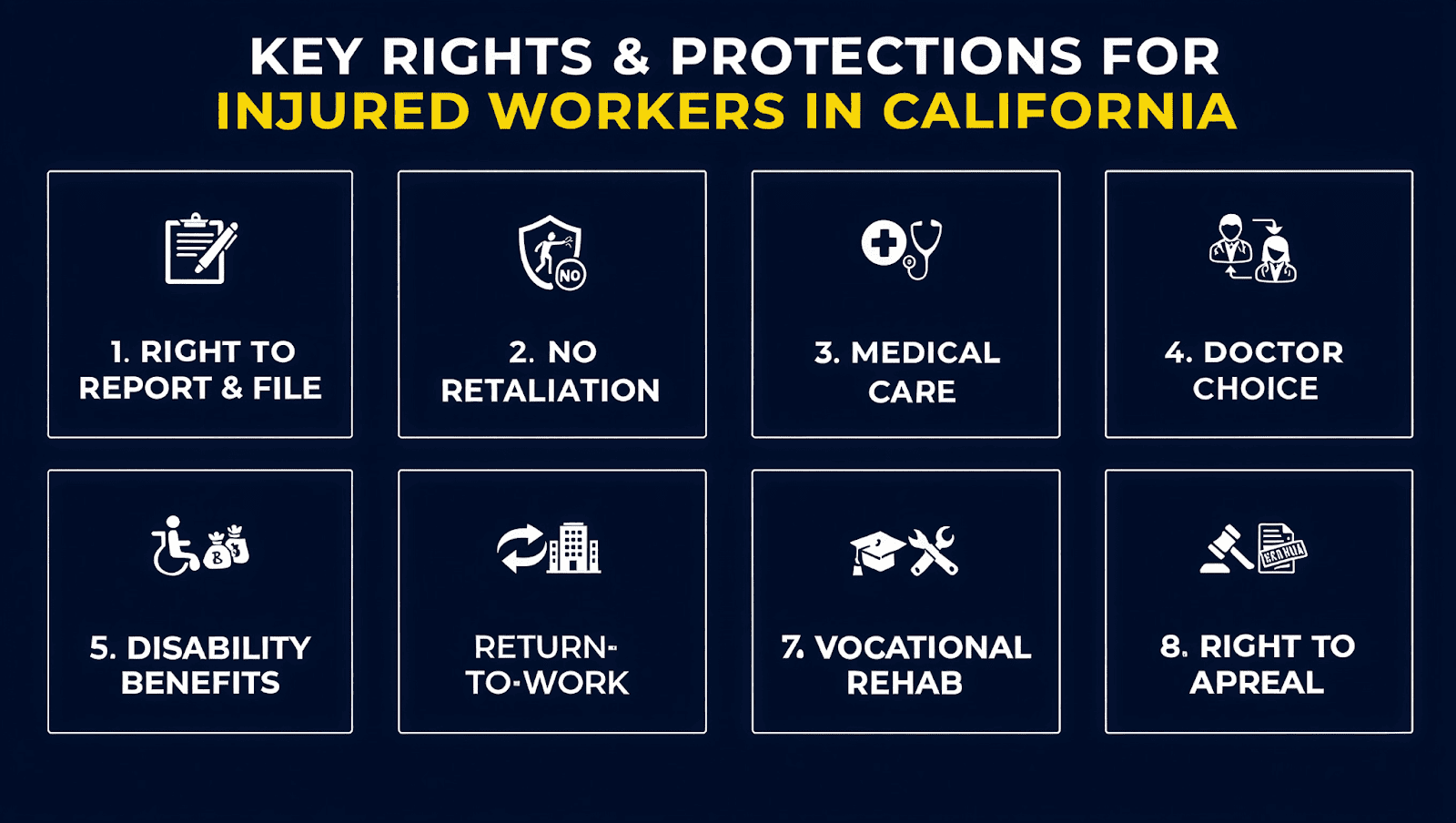
This post examines some key employee rights and legal protections during workplace injuries. Although these rights and protections are significant, they’re just ink on paper unless a workplace injury law firm in Los Angeles protects these rights. Mostly to save money, employers and insurance companies trample on employee rights and protections whenever possible. A workplace injury law firm helps ensure that employee rights are protected and that they receive fair compensation during workplace injuries.
The unquestioned right to a safe workplace is the foundation of everything else. The Triangle Shirtwaist Factory fire is the foundation of this foundation, if you follow us. Knowing where the right to a safe workplace came from helps victims and workplace injury law firms alike know where they’re going.
This 1911 fire in New York City killed 146 people. The real tragedy is that nearly all those deaths were preventable.
The factory was a sweatshop in every sense of the word. Employees, mostly immigrant women and young girls, worked fourteen-hour shifts five days a week. They worked eight-hour shifts on Saturday and Sunday.
The fire probably began in a rag bin. A firehose was moldy and the valve was rusted shut, and the factory didn’t have sprinklers. Panic ensued as the doors were locked to prevent theft. Smoke inhalation and the flames themselves killed a few victims. But most died when they jumped from 8th, 9th, or 10th story windows in a desperate attempt to flee.
Over the years, the right to a safe workplace broadened, to include work-from-home (WFH) employees. WFH employees have the same right to a safe workplace as onsite employees. Employers must ensure that WFH spaces are free from fall and other injury hazards. Because of this similarity, WFH employees are eligible for workers’ compensation benefits just like onsite employees. More on that below.
The right to a safe workplace also includes the right to report an injury, encourage someone else to report an injury, or serve as a witness in a job injury investigation.
Tragedies like the Triangle Shirtwaist Factory Fire gave birth to the workers’ compensation system. Employees waived their right to sue for injuries in court in exchange for a no-fault benefit system that paid:
“No fault” does not mean “no problem.” Insurance companies routinely contest liability and damages in these situations.
Workers’ compensation benefits are unavailable if a pre-existing or non-work condition substantially caused the illness or injury. There’s a significant difference between a contributing cause and a substantial cause.
Damage disputes usually involve the reasonable necessary rule for medical bill payment. Many insurance companies erroneously believe “reasonably necessary” is a synonym for “cheapest available.”
In some cases, injured California workers may file civil claims and obtain additional compensation for emotional distress and other noneconomic losses. Common nonsubscriber cases include uninsured employers and intentional or reckless injuries.
Just like workers have the right to complain about unsafe workplaces, they also have an absolute right to file workers’ compensation claims. Employers cannot fire, demote, threaten, punish, harass, or take any other adverse actions against employees who assert their legal rights.
A few final words about employee rights and legal protections that apply to all workers, not just work-related illness or injury victims.
Under the Family Medical Leave Act, California workers are entitled to twelve weeks of unpaid leave in any twelve-month period, if they’ve worked for their employers for at least twelve months, have worked at least 1,250 hours over the past twelve months, and work for an employer with at least 50 employees within a 75-mile radius. Some limitations and exclusions apply.
Another federal law, the Americans with Disabilities Act, ensures the right to a reasonable accommodation. If an employee can perform core job requirements, these accommodations include modified duties, light-duty assignments, schedule or workstation adjustments, and assistive devices.
Knowing your workplace rights makes it easier to assert them. For a free consultation with an experienced workplace injury law firm in California, contact the Law Offices of Eslamboly Hakim. The sooner you reach out to us, the sooner we start working for you.
We’re here to ease your stress and guide you through every step of recovery.
Get Support NowYes. Even in an at-will state, employers must follow workplace safety laws and cannot violate employee protections after an injury.
You have the right to work in an environment free from known hazards, whether you work onsite or from home.
Yes. California law provides the same workplace safety protections and workers’ compensation coverage to remote employees.
Workers’ compensation covers medical treatment, wage replacement, and disability benefits for job-related injuries or illnesses.
No. Retaliation for reporting an injury or filing a claim is illegal under California law.
A pre-existing condition does not automatically disqualify you. If work was a contributing cause, benefits may still apply.
No. Treatment must be reasonably necessary, not simply the cheapest option available.
Civil claims may apply if an employer is uninsured, acted recklessly, or intentionally caused harm.
Yes. Eligible California employees may take protected leave under the Family Medical Leave Act and related state laws.
Reasonable accommodations may include modified duties, schedule changes, assistive devices, or light-duty work if you can perform core job tasks.
Tag:
I like the fight – the fight to hold Big Insurance accountable, the fight to find justice for real people, and the fight to level the playing field for...Read More
