 1-800-529-8255
 1-800-529-8255

 Back
Back
 Trip and Fall: $200,000 Recovered
 How to Find Your Car Accident Lawyer If You Lost All Contact Information
Many victims panic if they cannot immediately contact their lawyers. Panic often leads to chain reaction thinking (I can’t find...
Read More
8730 Wilshire Boulevard, California 90211 
Get Help Now

Request A free confidential case review

Case Results :
Recently Written:

Many victims panic if they cannot immediately contact their lawyers. Panic often leads to chain reaction thinking (I can’t find...
Read More

Bicycle accidents, especially in areas like Los Angeles, are on the rise. When compared with vehicle-on-vehicle accidents, bicycle-on-vehicle accidents often...
Read More

Investigators aren’t sure why a pedestrian was in one of the northbound 110 lanes on October 30, 2025. Investigators are...
Read More
Investigators believe that alcohol intoxication was a factor in a September 14, 2025, crash that seriously injured a half-dozen motorists...
Read More

Mostly thanks to advancing technology, fatal airplane accidents are very rare. However, statistics don’t comfort people who lose friends or...
Read More
Partner with our experienced attorneys and take the first step toward justice.
Get Your Free Consultation

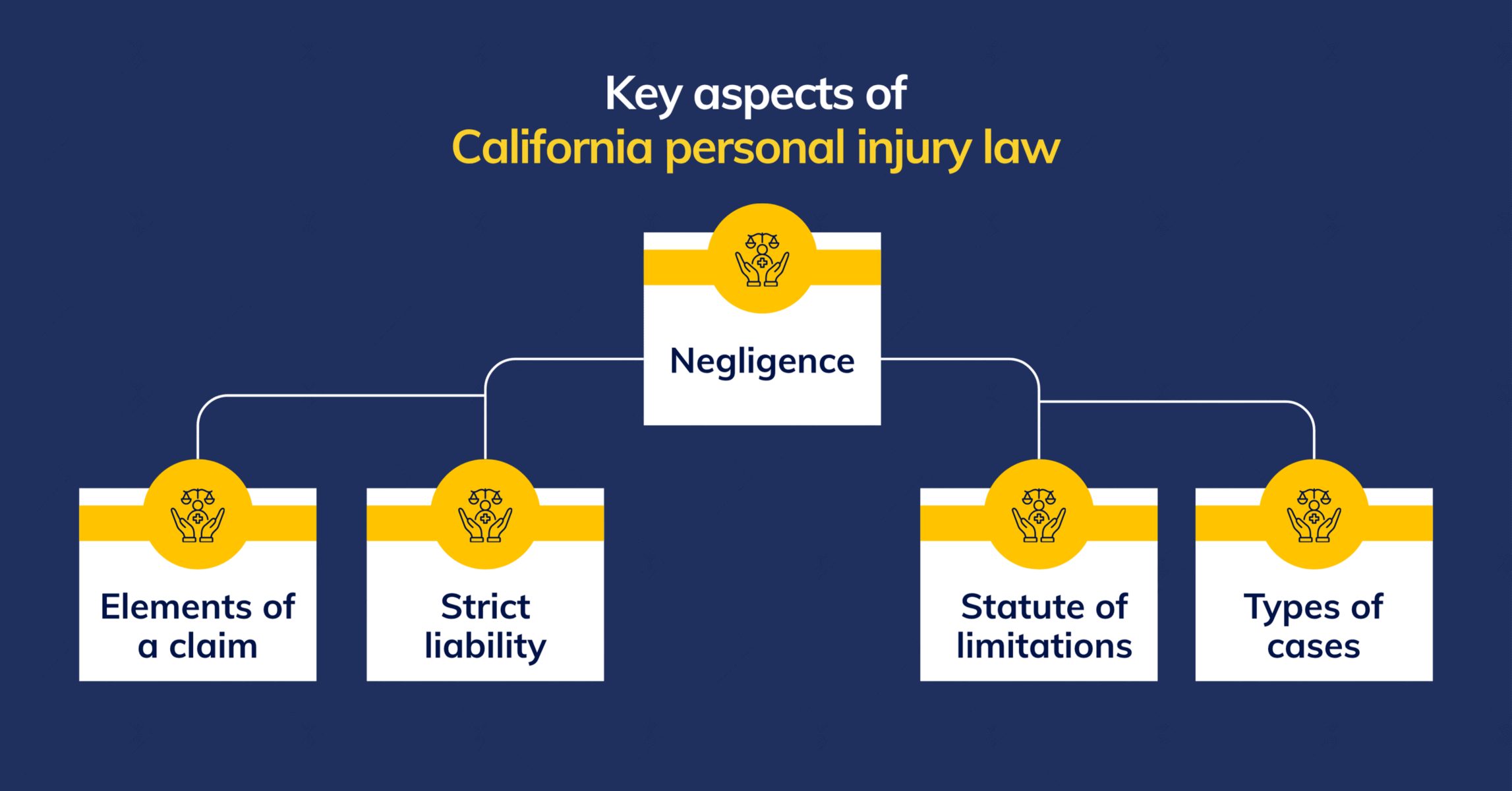
You break it, you buy it. In a nutshell, that’s negligence, which is the personal injury law in California. If Paul unintentionally drops a coffee mug and breaks it, he should pay compensation (replace the mug).
Similarly, if Paul unintentionally crashes into another car and “breaks” someone, he should likewise pay compensation. Compensation is much higher in a California personal injury case because a person is worth infinitely more than a coffee mug.
In a perfect world, Paul voluntarily steps up and pays fair compensation. But we don’t live in a perfect world. Therefore, a Los Angeles personal injury attorney must get involved, advocate for the victim, and compel Paul to accept responsibility for his mistake. California would be a much better place to live if we all faced the music after we made mistakes.
As outlined below, California negligence law isn’t a “law” as such, at least in most situations. Instead, California negligence law is based on a series of cases, many of which are more than two hundred years old. So, most aspects of California negligence law are very well-settled.
Vaughan vs. Menlove (1837) was one of the first negligence cases. At that time, many houses in merry old England had thatched roofs. As the hay decomposes, the process generates heat. Without adequate ventilation, the heat causes the hay to spontaneously combust.
In this case, the defendant built a hay rick (or haystack) near the border of the plaintiff’s land. Although the defendant added a precautionary chimney to his hay rick, the chimney was defective. Over a period of several weeks, several people warned the defendant of the danger, but he said “he would chance it.” Consequently, the hay ignited and spread to the plaintiff’s land, burning down two of the plaintiff’s cottages.
The jury sided with the plaintiff. On appeal, the defendant said he’d done his best, the fire was an accident, and “he ought not to be responsible for the misfortune of not possessing the highest order of intelligence.” In response, the court ruled that:
whether the Defendant had acted honestly and bona fide to the best of his own judgment . . . would leave such a vague line as to afford no rule at all. We ought rather to adhere to the rule which requires in all cases a regard to caution such as a man of ordinary prudence would observe.
This pronouncement became the duty of reasonable care, which applies in most personal injury cases in California. For example, drivers have a duty of care to follow the rules of the road and avoid accidents when possible.
If a breach of duty, usually aggressive driving or operator impairment, substantially causes injury, a Los Angeles personal injury lawyer can obtain compensation for economic losses, such as medical bills, and noneconomic losses, such as pain and suffering.
Sometimes, the law establishes the standard of care. That was the situation in Gorris v. Scott (1874), one of the first negligence per se cases.
A storm washed a flock of sheep overboard. The owner claimed the accident happened because of the defendant’s failure to transport his sheep in pens, as required by the Contagious Disease Act.
This time, the plaintiff didn’t fare as well. The court held that the statute was intended to prevent the spread of disease, rather than the loss of livestock in transit. So, the plaintiff could not claim negligence per se.
By the same logic, if Susan was drunk when she ran a red light and crashed into Luis, Susan was negligent as a matter of law, even though running the red light, not her intoxicated state, technically caused the crash.
California, like most other states, is a comparative fault state. If both parties were partially responsible for a personal injury accident, the court could reduce the plaintiff’s compensation, as was the case in Davies vs. Mann (1842).
The plaintiff allowed his donkey to take a break and graze on the side of the road. Unbeknownst to him, the defendant’s horse-drawn cart was approaching “at a sportish speed.” As a result, the cart ran against the ass, killing the donkey.
Almost immediately after the accident, the finger-pointing began. A court ultimately ruled that both men were partially responsible for the incident. The plaintiff should have led his donkey to a safe location, and the defendant should have watched where he was going.
Responsibility is the core principle of California negligence law. For a free consultation with a personal injury attorney in California, contact the Law Offices of Eslamboly Hakim. The sooner you reach out to us, the sooner we start working for you.
We’re here to ease your stress and guide you through every step of recovery.
Get Support NowPersonal injury law in California is based on negligence—if someone carelessly causes harm to another person, they must compensate the victim for their losses.
Negligence means failing to act with the care that a reasonable person would use in similar circumstances, leading to someone else’s injury.
Negligence per se applies when a person breaks a law or safety rule, and that violation directly causes someone’s injury. It automatically establishes negligence.
California follows pure comparative fault, meaning if both parties share blame, each pays for their percentage of fault. Even a partially at-fault victim can recover damages.
An experienced attorney helps prove negligence, handle insurance negotiations, and secure fair compensation for medical bills, lost wages, and pain and suffering.
Tag:
I like the fight – the fight to hold Big Insurance accountable, the fight to find justice for real people, and the fight to level the playing field for...Read More
